
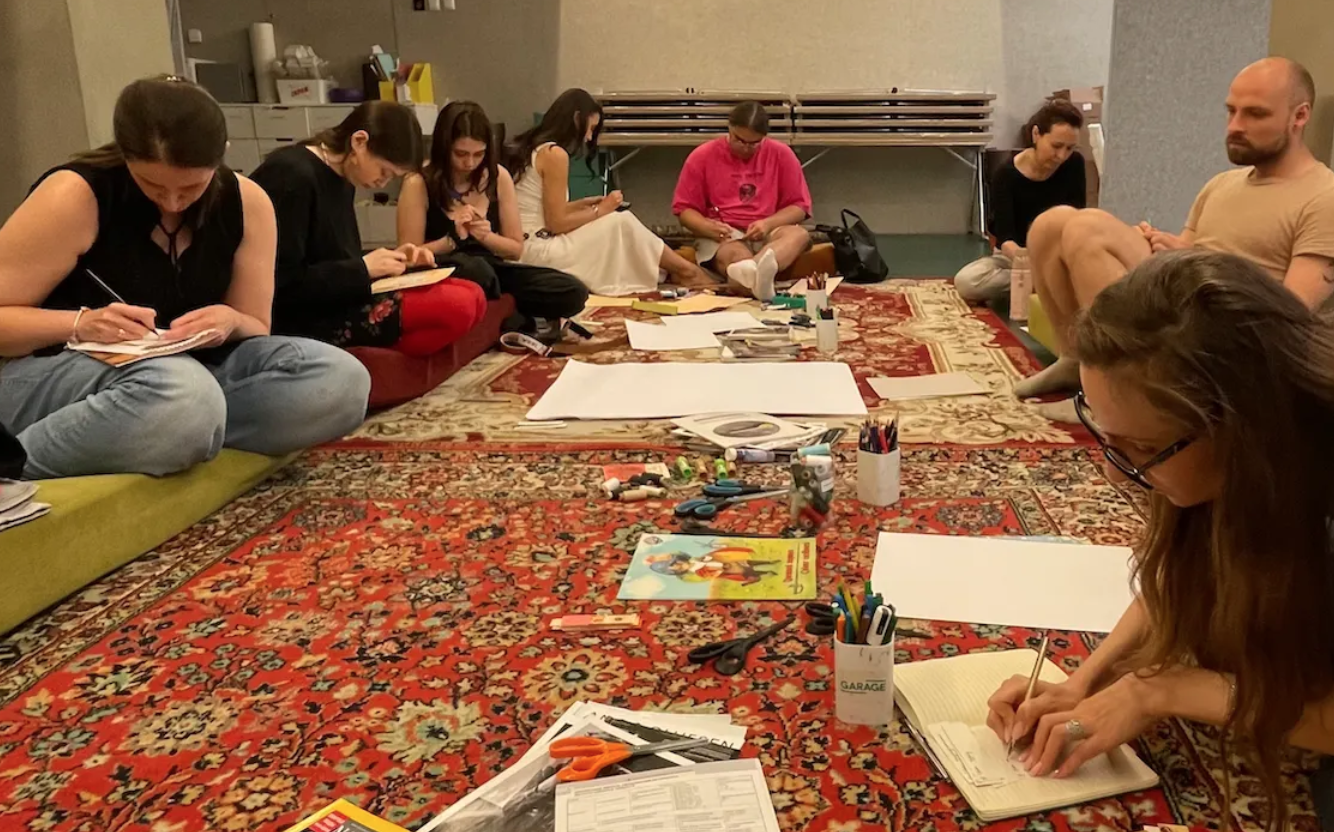
I was invited as an expert to the Garage Museum of Contemporary Art in Moscow during their program on sustainability and rethinking fast fashion. The invitation came from Aleksandra Dobryanskaya, the curator of the program, who discovered my work through Fashion Revolution. She reached out not for a typical fashion workshop, but for the perspective I bring — one that combines sustainability, emotional inquiry, and the intimate language of making.
My workshop, “Very Personal Things: How to Turn a Story into Fabric,” stood within the series “Serious Relationships: Rethinking Fast Fashion.” The program aimed to explore how textiles intersect with art, responsibility, and memory. I entered this space not to teach people how to sew, but to ask: What do we hold onto, and why? What do we mend, and what do we allow to unravel?
Why I Was There
I was invited because my practice challenges the conventional structure of fashion education. With a background in critical fashion and design education, I create environments where making becomes a form of understanding. I do not follow linear instruction. Instead, I work with guided meditation, collective reflection, and serendipity. I introduce the unexpected — exchanges, idea theft, interruptions — because sustainability is not a straight line; it is a cycle of loss, discovery, and return.
Inside the Workshop
Participants arrived with garments that carried their histories, nothing new was allowed to be purchased for the workshop, only a discarded pieces that were about to be thrown away anyways. The group included textile artists, educators, historians, and skeptics. Yet in the space we created, hierarchy dissolved and everybody started the process of unpick seams, we ought to destroy before repurposing, this mere action sparked a lot of resistance both a as emotional and physical, when people refused to move and “ruin” the item.
There was a moment I remember clearly. One participant questioned the ambition the workshop was going to achieve when working with over twenty people within four hours, as each of them was holding deeply personal themes. But by the end, she approached me and said she had not believed it was possible to guide a group through such complexity, and yet have every person reach a point of inner clarity. I guess it is the framework that is includes every one of them and still has its timeframe for each task and exercise that everyone will reach to the very end of the workshops at the sometime but with their own revelations, and the textile in their hans was there to help them understand.
“I hear and I forget. I see and I remember. I do and I understand.”
— attributed to Confucius
What We Created
The pieces made in the workshop were not final objects; many were taken home, unfinished. That was intentional. Some participants wrote to me later, saying they had found answers to questions they had carried for a year. Others continued stitching, allowing time to reveal what words could not.
In this workshop they materialised what they could no articulate for a while. They created reminders, and the textile is being the witnesses o heir inner transformation, to keep them accountable to keep on going the self exploration process.
What This Meant for Garage
Garage Museum did more than host a workshop; they engaged in critical discourse. They offered space, care, and institutional trust. They understood that sustainability is not a subject. It is a practice.
There was no runway. No spectacle. No final output to display. What remains is transformation — quiet, interior, and irreversible. Participants departed with a previously discarded garment that was no longer waste., it became the beginning of another deeper story.
As a Fashion Revolution representative in Russia and board advisor to the local team, I introduce the idea of ethics in fashion and consumption, and the responsibility we must assume when bringing any textile piece into our wardrobe. With that in mind, I facilitate guided processes, spaces where uncertainty is welcomed and creativity is allowed in all its shapes and forms.
Why This Work Matters — Fast Fashion in Context
In an industry defined by acceleration, this work is resistance.
According to the United Nations Environment Programme (UNEP):
- Over 100 billion garments are produced every year.
- Every second, a truckload of textiles is landfilled or burned.
- By 2030, global clothing consumption is projected to increase by 63%.
Against this backdrop, workshops like Very Personal Things are not hobbies. They are interventions. They reintroduce slowness where speed dominates, intimacy where anonymity reigns.
Conclusion — Making as Understanding
These encounters with fabric teach what language cannot. We are not mending garments, we use them as a medium to understand our processes.
Through unmaking, we confront consumption. Through stitching, we honour memory. Through collective making, we reimagine responsibility.
At Garage, we did not design fashion. We designed understanding, memory and responsibilty.
Sources Referenced:
Garage Museum. (2025). Very Personal Things: Practice, Memory, and the Language of Textiles. https://garagemca.org/event/wor%D1%84kshop-by-anita-gray
Fashion Revolution. (2023). Fashion Transparency Index. Fashion Revolution.
United Nations Environment Programme (UNEP). (2022). A new textiles economy.
Ingold, T. (2013). Making: Anthropology, archaeology, art and architecture. Routledge.
Fletcher, K. (2016). Craft of use: Post-growth fashion. Routledge.





Comments
( 0 comment )
Please login to leave a comment.