
By Mr. Andrew Tey, Centre Director of CGTI
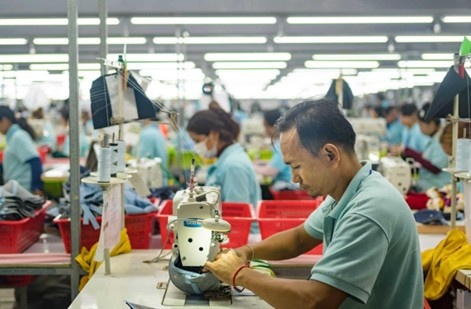
Cover image credits to ILO BFC
ESG as Cambodia’s New Competitive Edge: How CGTI Is Preparing the Future Workforce for the GFT Sector
The global Garment, Footwear, and Travel Goods sector is entering a new era. For many years, factories competed mainly on price, production capacity, quality, delivery speed, and basic compliance. These factors remain important, but they are no longer enough to secure long-term competitiveness. Today, global buyers, regulators, investors, and consumers are asking deeper questions: How was the product made? Were workers treated fairly? Was energy used responsibly? Were chemicals controlled properly? Can the factory prove its environmental and social performance with reliable data?
This is where ESG — Environmental, Social and Governance — becomes a strategic priority for the GFT sector.
ESG is no longer only a corporate reporting topic. It is becoming a business requirement, a buyer expectation, a market access condition, and a new benchmark for responsible sourcing. For Cambodia’s GFT sector, ESG represents both a challenge and an opportunity. The challenge is that factories must upgrade their systems, data, people, and practices. The opportunity is for Cambodia to position itself as a responsible, sustainable, and future-ready sourcing destination.
Cambodia’s GFT sector remains one of the country’s most important economic pillars. In 2025, Cambodia exported approximately US$15.7 billion worth of garments, footwear, and travel goods, a year-on-year increase of 15.8%, according to official figures reported by AKP from the Ministry of Labour and Vocational Training. (https://akp.gov.kh) Better Factories Cambodia also reported that in 2025 the sector comprised 1,810 firms, employed more than 1.11 million workers, and accounted for 51.8% of Cambodia’s total exports. (Better Work)
These numbers show the sector's strength. They also show the sector's responsibility. When an industry supports over one million livelihoods and contributes significantly to national exports, ESG cannot be treated as a side activity. It must become part of the sector’s future competitiveness strategy.
Why ESG Matters More Than Ever
The international market is changing rapidly. Buyers are under pressure to demonstrate responsible sourcing, reduce carbon emissions, manage human rights risks and ensure transparency across their supply chains. In the past, passing an audit was often enough. In the future, factories will increasingly need to show continuous improvement, supported by accurate data, strong documentation and credible management systems.
The European Union’s 2030 vision for textiles is that textile products placed on the EU market should be durable, repairable, recyclable, largely made from recycled fibres, free of hazardous substances, and produced with respect for social rights and the environment. (Environment) The EU Corporate Sustainability Due Diligence Directive, which entered into force in July 2024, aims to ensure that companies in scope identify and address adverse human rights and environmental impacts in their operations and global value chains. (European Commission)
This means the expectations placed on factories will continue to increase. Buyers will not only ask whether a factory can produce at the right price and quality. They will also ask whether the factory can provide evidence on energy use, greenhouse gas emissions, chemical management, waste control, occupational safety and health, labour practices, grievance systems, supplier control and due diligence.
For Cambodia, this is especially important as the country prepares for the next stage of industrial development and future trade competitiveness. ESG should not be seen as a burden. It should be seen as a pathway to protect market access, improve factory performance and move the sector toward higher-value, more responsible production.
The Environmental Pillar: From Green Compliance to Green Productivity
The environmental pillar of ESG is often linked to climate change and carbon emissions. However, in the GFT sector, environmental responsibility begins inside the factory. Energy consumption, boiler efficiency, compressed-air leakage, lighting systems, water use, wastewater treatment, material waste, packaging, chemical storage, and production planning all affect a factory's environmental footprint.
For factories, environmental ESG should not be limited to reporting. It should become part of operational excellence. A factory that reduces energy waste also reduces cost. A factory that improves chemical management reduces worker health risks and environmental exposure. A factory that improves waste segregation and material utilisation reduces disposal costs and supports circular economy practices.
Tools such as the Higg Facility Environmental Module are used by the apparel, footwear, and textile industries to assess facility-level environmental performance across areas such as energy, water, wastewater, waste, chemicals, and greenhouse gas emissions. For Cambodian factories, the real value of such tools is not only the score, but the improvement journey. ESG must move from checklist compliance to measurable performance improvement.
This is where technical capability becomes critical. Factories need trained staff who can collect data, interpret environmental indicators, prepare improvement plans and support management decisions. The future factory will need people who understand both production and sustainability.
The Social Pillar: Workers, Safety and Human Rights at the Centre
The social pillar is highly important for Cambodia because the GFT sector is a people-centred industry. More than one million workers depend on the sector, and a large proportion of the workforce is women. (Better Work) Therefore, ESG cannot be credible if it does not improve worker wellbeing, occupational safety and health, skills development, and responsible labour practices.
In the past, social compliance was often treated as an audit requirement. The future requires a more mature approach. Factories need stronger systems for occupational safety and health, worker communication, grievance handling, industrial relations, respectful supervision, emergency preparedness, gender-responsive workplace practices, fair recruitment, and human rights due diligence.
Human Rights and Environmental Due Diligence, or HREDD, is becoming increasingly important because global buyers are expected to identify, prevent, mitigate, and address human rights and environmental risks in their supply chains. The OECD Due Diligence Guidance for Responsible Supply Chains in the Garment and Footwear Sector provides practical guidance to help enterprises address potential adverse impacts in their supply chains. (EuroCham Cambodia)
For factories, this means social ESG must move beyond documents. It must be demonstrated through workplace practices: safer working conditions, trained supervisors, functioning grievance mechanisms, responsible overtime management, worker engagement, proper subcontracting control and continuous improvement.
A socially responsible factory is not a weaker factory. It is a stronger factory. Workers who are trained, respected and protected are more likely to stay, perform well and support productivity improvement. Strong OSH practices reduce accidents, disruption and absenteeism. Good worker communication reduces conflict. Better supervision improves quality, morale and efficiency.
The Governance Pillar: Data, Integrity and Accountability
Governance is the pillar that makes ESG believable. Without governance, environmental and social commitments become only slogans. With governance, ESG becomes a management system.
For the GFT sector, governance means clear policies, responsible persons, documented procedures, accurate records, internal audits, corrective actions, supplier control, management review and transparent reporting. It also means preventing corruption, managing conflicts of interest, controlling subcontracting and ensuring that ESG data is accurate and verifiable.
The factories that will be most competitive in the future are those that can produce reliable ESG evidence quickly. They will have organised records for energy, water, waste, chemicals, OSH incidents, training hours, worker turnover, grievance cases, audit findings and corrective actions.
This is why ESG data management is becoming a new core skill. Factories need staff who can manage ESG dashboards, prepare monthly reports, analyse trends and support management decisions. ESG is no longer only the responsibility of the compliance department. It involves production, HR, maintenance, warehouse, purchasing, quality, finance and top management.
CGTI’s Role: Building ESG Skills for the Future of the GFT Sector
As the training arm supporting Cambodia’s GFT sector, the Cambodian Garment Training Institute (CGTI) plays an important role in helping factories move from ESG awareness to ESG implementation. The future of ESG depends not only on policies and buyer requirements, but also on people. Factories need trained managers, supervisors, officers and technicians who understand how to apply ESG in daily operations.
CGTI can position itself as a practical industry capacity-building centre for ESG transformation by offering training programs that connect sustainability, compliance, productivity and workforce development.
CGTI ESG-Aligned Training Areas
- Human Rights and Environmental Due Diligence Training
CGTI’s HREDD-related training can help factories understand buyer expectations, due diligence requirements, and responsible business conduct. This training can cover human rights risks, environmental risks, grievance mechanisms, supplier mapping, risk assessment, corrective action planning, and documentation.

This is important because HREDD is no longer only a European or buyer-level discussion. It is becoming a factory-level responsibility. Factories must understand how to identify risks, prevent negative impacts, and provide evidence of improvement.
Suggested CGTI course positioning:
Human Rights and Environmental Due Diligence for the GFT Sector
A practical training course for compliance officers, HR managers, sustainability officers, production managers and senior factory leaders.
- Occupational Safety and Health Training
OSH is one of the strongest social ESG pillars. A factory cannot claim to be sustainable if workers are exposed to unsafe conditions. CGTI’s Occupational Safety and Health programs, including the Advanced Diploma in OSH, can support the sector by developing competent OSH officers, safety supervisors, and risk-prevention personnel.
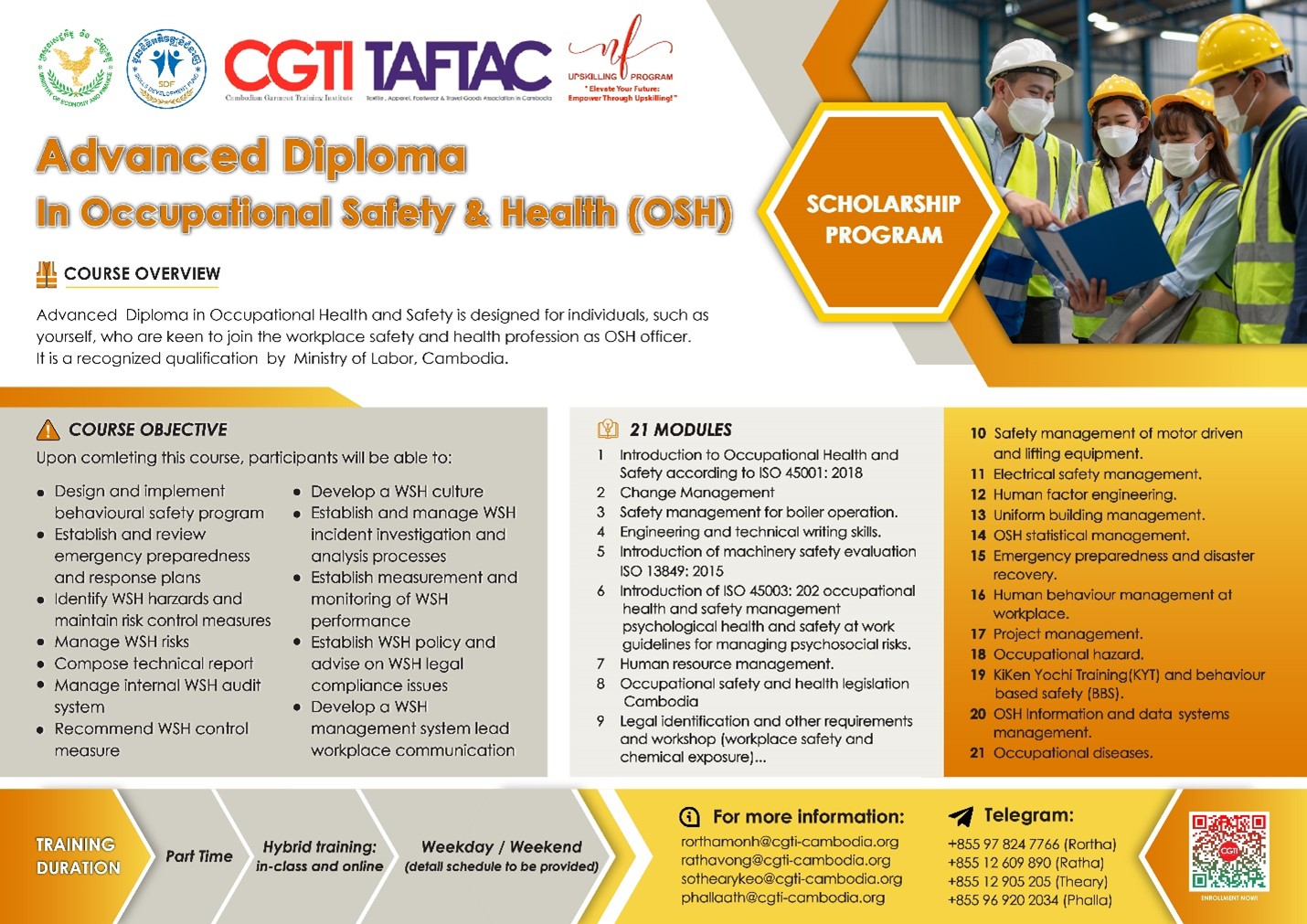
The training can include hazard identification, risk assessment, accident investigation, emergency preparedness, machine safety, chemical safety, fire safety, ergonomic risks, PPE management, legal compliance and safety culture.
Suggested CGTI course positioning:
Advanced Diploma in Occupational Safety and Health for the GFT Sector
A professional pathway to develop OSH personnel who can support safer, more compliant and more productive factories.
- Energy and Environmental Sustainability Training
The environmental pillar of ESG requires technical capability. CGTI’s Energy and Environmental Sustainability programs, including the Advanced Diploma in Energy and Environmental Sustainability, can help factories develop personnel who understand energy data, water consumption, waste management, greenhouse gas reduction and environmental improvement projects.
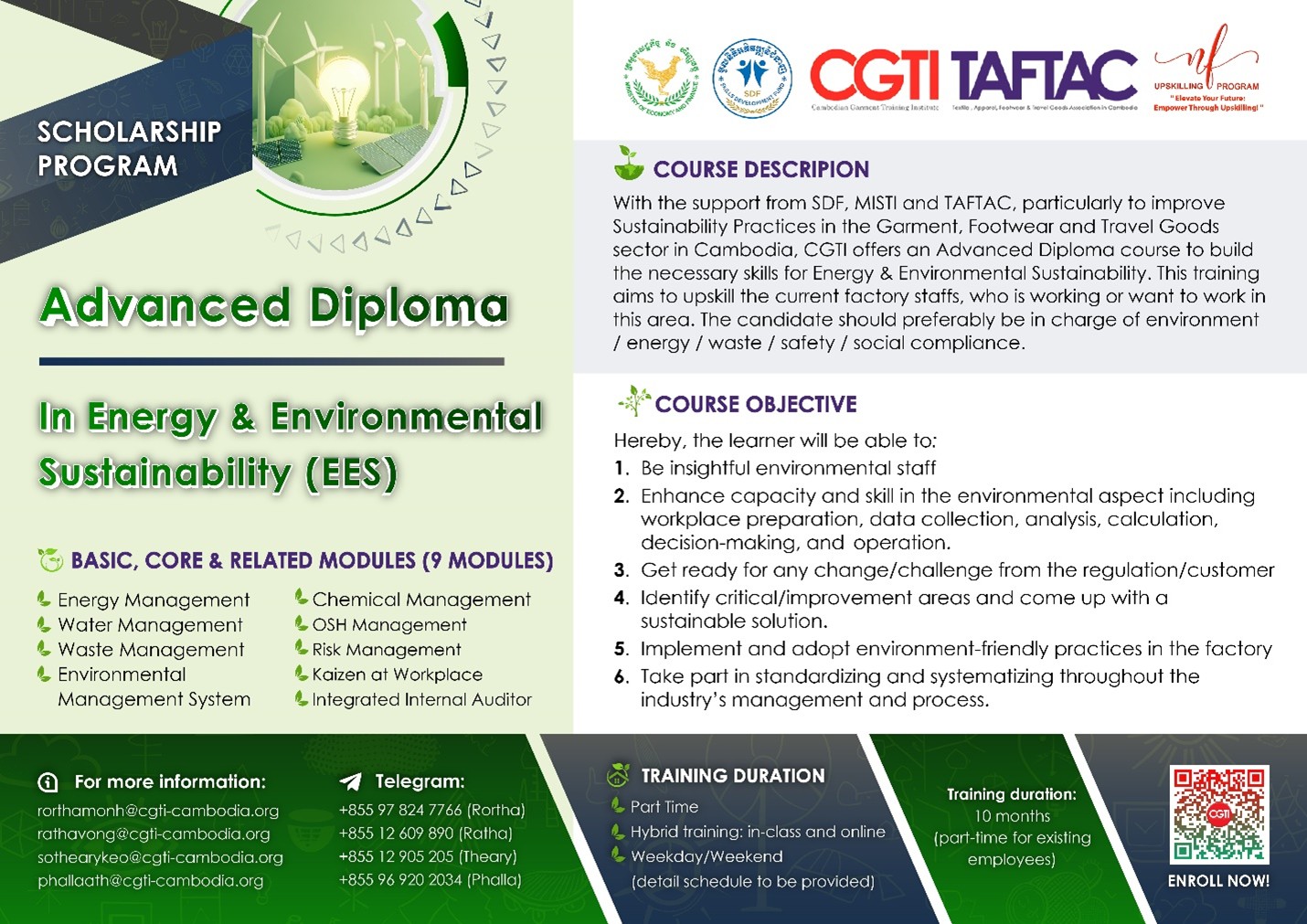
This training is especially important for factories that need to improve Higgs FEM performance, prepare environmental reports, reduce operating costs and support buyer sustainability requirements.
Suggested CGTI course positioning:
Advanced Diploma in Energy and Environmental Sustainability for the GFT Sector
A practical work-based program to train environmental officers and sustainability coordinators for factory-level ESG implementation.
- Higgs FEM and Environmental Data Management Training
Many factories face challenges not because they do not want to improve, but because they do not know how to collect, analyse, and use data. CGTI can support factories through training on Higgs FEM, environmental data management, energy monitoring, waste tracking, chemical inventory control and corrective action planning.
This type of training helps factories move from “answering questions” to “managing performance.” It also supports better communication with buyers.
Suggested CGTI course positioning:
Higg FEM Practical Improvement and Environmental Data Management
A hands-on training course for sustainability officers, compliance teams, maintenance staff, and factory managers.
- Lean Green Factory and Resource Efficiency Training
ESG should not be separated from productivity. Lean and ESG can work together. Lean reduces waste, improves flow, and increases efficiency. Green practices reduce energy, water, material, and environmental waste. When combined, Lean Green Factory training can help factories improve both cost competitiveness and sustainability performance.
CGTI can promote this as a practical course for production, IE, maintenance and sustainability teams.
Suggested CGTI course positioning:
Lean Green Factory for the GFT Sector
A practical training course linking productivity improvement, energy efficiency, waste reduction, and ESG performance.
- Circular Economy and Waste Management Training
The future of the textile and apparel industry is moving toward circularity. This includes reducing waste, improving material efficiency, reusing materials, recycling textile waste and designing better systems for resource recovery. As global markets move toward more circular textile expectations, Cambodian factories need to understand how circular economy concepts apply to daily production.
CGTI can support factories with training on waste mapping, material flow, segregation, textile waste reduction, recycling opportunities, packaging reduction and circular improvement projects.
Suggested CGTI course positioning:
Circular Economy and Waste Management for GFT Factories
A practical course to help factories reduce waste, improve material efficiency and prepare for future circular textile requirements.
- ESG Leadership and Governance Training
ESG transformation requires leadership. Factory owners, senior managers and department heads must understand how ESG affects competitiveness, buyer confidence, risk management and long-term business sustainability.
CGTI can offer ESG leadership training for top and middle management, focusing on ESG strategy, governance structure, KPI setting, data review, internal accountability and continuous improvement.
Suggested CGTI course positioning:
ESG Leadership for GFT Factory Management
A strategic program for senior leaders to integrate ESG into business planning, operational management and buyer engagement.
CGTI as a Strategic ESG Capacity-Building Partner
CGTI is well-positioned to support the GFT sector because ESG transformation requires practical, industry-based training rather than theory alone. Factories need training that is connected to real production challenges, real buyer expectations and real improvement projects.
Through ESG-aligned courses, CGTI can help factories develop the following new capabilities:
ESG Area | Factory Need | CGTI Training Support |
Environmental | Energy, water, waste, chemicals, GHG data | Energy & Environmental Sustainability, Higg FEM, Environmental Data Management |
Social | OSH, worker wellbeing, labour standards, human rights | Advanced Diploma in OSH, HREDD, Industrial Relations, Supervisor Training |
Governance | Policies, data, evidence, corrective actions, supplier control | ESG Governance, Internal Audit, ISO Management Systems, Due Diligence Training |
Productivity & Sustainability | Cost reduction, resource efficiency, waste reduction | Lean Green Factory, Kaizen, Circular Economy |
Future Skills | ESG officers, sustainability coordinators, OSH officers, data officers | Work-based learning, Advanced Diploma and Advanced Certificate pathways |
This positioning allows CGTI to promote itself not only as a training provider but as an industry transformation partner. CGTI can help factories build the people, systems, and competencies needed to meet ESG requirements and buyer expectations.
From Training to Factory Impact
The strongest ESG training is not only classroom-based. It should lead to measurable factory improvement. CGTI can strengthen its ESG courses by linking each program to workplace projects. For example:
- A participant in the Energy and Environmental Sustainability program could complete a factory energy baseline and recommend energy-saving actions.
- A participant in the OSH program could conduct a workplace risk assessment and develop a corrective action plan.
- A participant in the HREDD course could map human rights and environmental risks in the factory supply chain.
- A participant in the Lean Green Factory course could reduce material waste or improve production flow.
- A participant in the Higg FEM course could prepare a data improvement plan for energy, waste, water, or chemicals.
This work-based approach makes ESG practical. It also helps factories see direct value from training. Instead of training being treated as a cost, it becomes an investment in improvement.
Why Factories Should Invest in ESG Skills Now
Factories that invest early in ESG skills will be better prepared for future market requirements. They will be able to respond faster to buyer questionnaires, prepare stronger audit evidence, reduce operational risks and identify cost-saving opportunities.
More importantly, ESG skills will help factories move from reactive compliance to proactive competitiveness. Instead of waiting for buyers to identify problems, factories can build internal capabilities to manage risks and continuously improve performance.
For Cambodia’s GFT sector, this is a major opportunity. If the sector can combine competitive production with responsible ESG performance, Cambodia can strengthen its position as a trusted sourcing destination.
Conclusion: ESG Is the Future, and Skills Are the Foundation
The future of the GFT sector will not be determined solely by low labour costs or production capacity. It will be decided by the ability to produce responsibly, efficiently, and transparently. ESG is becoming the new standard for global competitiveness.
For Cambodia, ESG should not be viewed as a burden. It should be viewed as an opportunity for national industry upgrading. It can help factories reduce costs, improve worker wellbeing, strengthen buyer confidence, protect market access, and prepare for future trade conditions.
CGTI has an important role in this transformation. By offering ESG-aligned training in HREDD, OSH, Energy and Environmental Sustainability, Higg FEM, Lean Green Factory, Circular Economy, and ESG Governance, CGTI can help factories develop the practical skills required for the next generation of responsible production.
The message for the GFT sector is clear: ESG is no longer optional. It is already shaping the future of sourcing, compliance, and competitiveness. The factories that invest in ESG skills today will be better prepared for tomorrow.
And for Cambodia, the future of the GFT sector must be green, responsible, skilled, data-driven, and globally trusted.





Comments
( 0 comment )
Please login to leave a comment.