
CGTI and Circle Economy Foundation Strengthen National Capacity for Responsible
The Garment, Footwear, and Travel Goods (GFT) sector remains one of Cambodia’s strongest economic pillars, employing hundreds of thousands of workers and driving the country’s export performance. Today, as global brands and consumers increasingly prioritize responsible and sustainable production, the sector faces growing pressure to minimize waste, conserve resources, and embed circular practices across its supply chains.
A circular economy presents a practical and future-focused solution to these challenges. By designing out waste, extending the life cycle of materials, and improving resource efficiency, circularity enables the GFT sector to enhance resilience, maintain competitiveness, and reduce its environmental impact. For Cambodia, this shift is not just an opportunity; it is essential for sustaining global market relevance.
As the country’s leading training institution for the GFT industry, the Cambodian Garment Training Institute (CGTI) plays a pivotal role in developing the skills needed for this transition. Through strategic partnerships, comprehensive capacity-building programs, and innovative training curricula, CGTI equips factories and workers with the knowledge and tools necessary to adopt responsible manufacturing practices.
Training of Trainers on Responsible Manufacturing for Circular Fashion
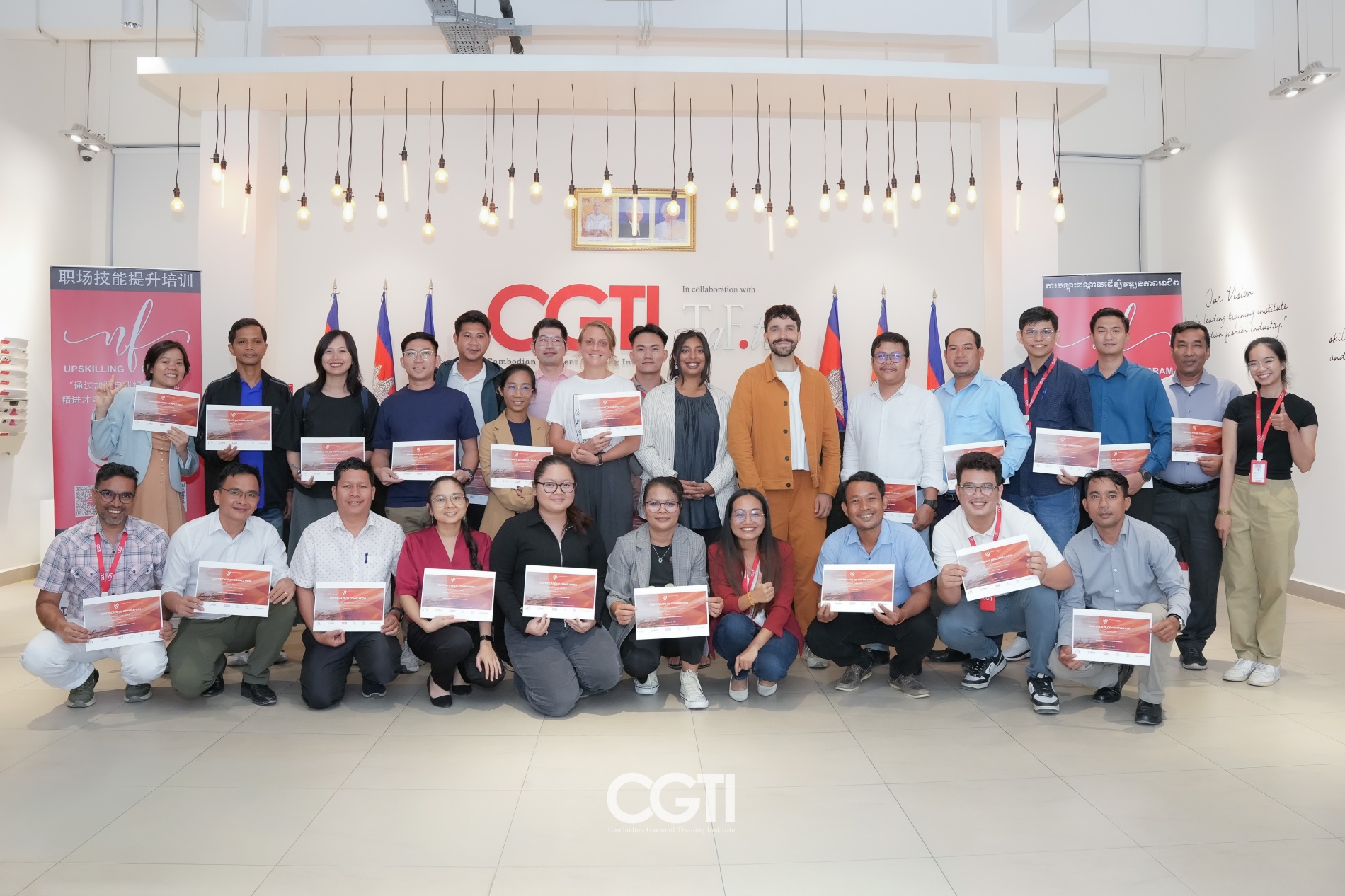
To accelerate national progress toward a circular GFT sector, the Circle Economy Foundation and CGTI co-organized a Training of Trainers (ToT) on Responsible Manufacturing for Circular Fashion on September 9–10, 2025. The program brought together diverse stakeholders, including:
- Government ministries
- International fashion brands
- Manufacturers
- Training and education institutions
- Social organizations and sustainability partners
The two-day training introduced participants to key circularity concepts, best practices in sustainable manufacturing, waste minimization techniques, and systems thinking approaches needed to support circular fashion adoption.
Upon completion, participants were certified as trainers, enabling them to disseminate knowledge and methodologies within their own organizations and across their networks. This cascading approach ensures a long-term, sector-wide impact and strengthens Cambodia’s capacity to meet global sustainability standards.
Scaling Up Circular Fashion Training in Cambodia
Building on the success of the initial ToT and with continued support from Circle Economy Foundation, CGTI has integrated circularity modules into its regular training programs. The institute continues to provide tailored training to factory staff, emphasizing practical solutions and industry-aligned tools.
A second circular fashion training session was held on October 31 - November 1, 2025, reaching an additional 50 participants working in sustainability, safety, and resource management roles.
This milestone marks a significant achievement: Cambodian trainers now lead circular economy training at scale using globally recognized methodologies. By empowering more trainers and practitioners with circular economy skills, CGTI reinforces its commitment to strengthening industry knowledge, expanding awareness, and ensuring long-term sustainability across the GFT sector.
Global Foundations for Local Impacts
Both training sessions were based on materials and methodologies created by Circle Economy through the Global Circular Fashion Forum, an international initiative designed to:
- Accelerate circularity in major textile manufacturing regions
- Promote the effective recycling of post-industrial textile waste
- Foster collaboration among brands, manufacturers, and recyclers
- Provide practical tools and learning resources for industry-wide adoption
This programme is part of the Circular Fashion Partnership (CFP) Cambodia, made possible through the support of the H&M Foundation, participating brands (adidas, H&M, Primark, Puma, lululemon), and is implemented together with Closed Loop Fashion, Reverse Resources, and the Circle Economy Foundation.
PDF Resource






Comments
( 0 comment )
Please login to leave a comment.